 Andrew Cordle
You guess on quarterly payments.
Estimated taxes get sized from last year or a rough number, so you overpay all year or catch up in April.

The service
How It WorksYour first year, step by stepTax StrategiesCreate, keep and multiplyAI TechnologyAI-driven. Human perfected.Your Tax TeamEvery expert, in one roomTaxLand AssessmentThe free game that maps your strategiesDiscover the tax strategies that fit your business in just a few minutes.

Year-round tax planning for freelancers, sole proprietors and single-member LLCs. We plan your retirement, health and business spending, and size your quarterly payments from real numbers, so April stops being a surprise.
Free. Takes a few minutes. No credit card.

Nobody withholds for you, nobody sets money aside, and nobody checks what you could have written off.
Estimated taxes get sized from last year or a rough number, so you overpay all year or catch up in April.
Without an employer plan, retirement and health savings wait until there is time, and there rarely is.
Home office, mileage and the costs you pay personally go unclaimed when no one tracks them through the year.
You don't need a corporation to plan. These are the three places we look first for a one-person business.
Save for later and lower this year's taxable income.
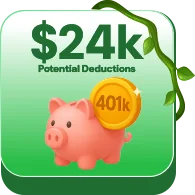
A solo retirement plan lets you contribute as both the employee and the business, so you can often set aside far more than a personal retirement account allows. Pre-tax or Roth, depending on the plan.
Good fit if you have no full-time staff besides a spouse.
Pay medical costs with money that was never taxed.

Deductible going in, tax-free growth, and tax-free coming out for medical costs. The money stays yours year to year.
Good fit if you're on a qualifying high-deductible plan.
Claim what you already spend to run the business.
Sole props deduct a qualifying home office on their own return. The space must be used regularly and only for business.
Your company reimburses the business share of your home, phone and mileage under Business Expenses, and deducts it.
Wondering whether to elect S-Corp? See tax strategy for established business owners. Kids who help in the business? See family tax strategies.
Eligibility depends on your situation. Your results depend on your facts and are not guaranteed.
Most solo owners start with Core. Signature adds a Tax Professional for more complex years.
 Core Plan
Personalized pricing
A Tax Valet and a written strategy, with your returns included.
 Signature Plan
Personalized pricing
Adds a Tax Professional to your team for more complex years.
Pricing is personalized and confirmed before you commit. Compare all plans.

What hooked me was how he simplified something complex so anyone can understand it.
Testimonials reflect individual experiences and are not a guarantee of future results.
Not always. An S-Corp election can help once profit is steady enough to cover a reasonable salary, payroll costs and the extra filing. We run the numbers for your situation and your state before recommending it.
Self-employed owners usually pay federal tax four times a year, around April 15, June 15, September 15 and January 15. We size each payment from your actual numbers so you are not overpaying all year or catching up in April. Your state may have its own schedule.
It depends on your work, but a qualifying home office, business mileage, and retirement and health savings are common places to look. We check what you qualify for and what records each one needs.
Yes. Bookkeeping is optional and you can add it mid-year. Clean books are what keep your strategies and estimates accurate.
Most one-person businesses start with Core. The free assessment and your call show whether Signature makes more sense, with the full price before you commit.
Nothing. It takes a few minutes, needs no credit card, and shows which strategies may fit before you talk to anyone.

See which strategies fit your business before December 31 decides for you.
Free. Takes a few minutes. No credit card.

 Your 2026 Strategy Plan
A few minutes in TaxLand shows which strategies fit your business.
See what you can keepFree. Takes a few minutes. No credit card.
Browse the first-call checklist.